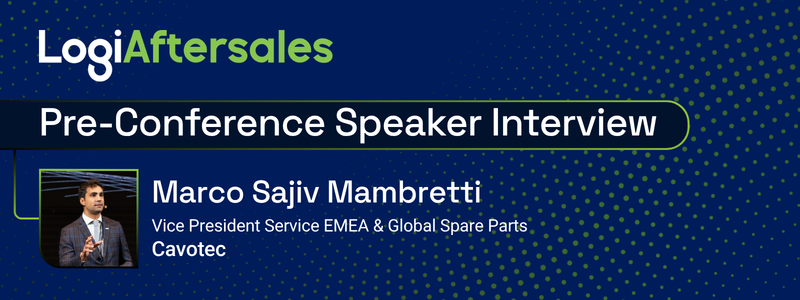
Speaker Interview with Marco Sajiv Mambretti, Vice President Service EMEA & Global Spare Parts at Cavotec
What do you see as the biggest challenge facing aftermarket supply chain and service logistics leaders over the next 3–5 years?
The tension between complexity and speed is only intensifying. At Cavotec we support customers across ports, mining and industrial facitilies in over 80 countries - equipment that is deeply embedded in mission-critical operations. What we're experiencing is that the installed base keeps expanding and ageing, product complexity keeps growing, and customers have less and less tolerance for downtime. Meanwhile, the supply chain environment is more fragile than ever - geopolitical volatility, longer lead times from key sourcing regions, and tighter logistics capacity all work against us. The biggest challenge is building a service supply chain that can absorb that external shock without it translating into a service failure for the customer. That requires a level of structural resilience and planning sophistication that most organisations, including ourselves, are still building.
How are customer expectations around uptime, service levels, and spare parts availability changing, and what does this mean for supply chain teams?
Customers are increasingly unwilling to absorb unplanned downtime as a cost of doing business. Across the sectors we serve - ports, mining and industrial facitilies - the economic consequence of a stopped operation is enormous, and that is raising the bar on what a credible service commitment looks like. SLAs are becoming more specific, penalties more meaningful, and the expectation is moving from "fix it fast" to "prevent it from happening." For supply chain teams, that shift is fundamental. It means you can no longer plan purely reactively. You need to be positioned upstream - with the right parts, in the right locations, before the failure occurs. That demands much tighter integration between field data, service forecasting, and inventory positioning. It is a significant operational lift. I feel we are just starting a journey where we need only to accelerate, some steps might be missed in between, but the end-objective is pretty crystalline. And this journey has to be shared with your customers, they need to be onboard. Our Service motto is simple and straightforward: schedule your maintenance before your equipment does it for you.
Inventory remains one of the biggest costs in aftermarket operations. How are leading organisations balancing parts availability with inventory optimisation?
This is one of the hardest problems in aftermarket - and honestly, there is no elegant solution, only good trade-offs. At Cavotec, we manage a very long product tail: equipment that can be in the field for 15–20 years, with demand for certain parts that is genuinely unpredictable. What we have learned is that blanket stocking policies don't work at this level of complexity. You need differentiated strategies - criticality-based segmentation, regional stocking hubs for fast-movers, central stock or supplier-managed inventory for slow-movers, and remanufacturing programmes to recover value on high-cost components rather than holding new stock indefinitely. We have built out a Reman offering across several product lines precisely for this reason. The goal is availability where it matters, without tying up capital where demand doesn't justify it.
What role do technologies such as AI, predictive analytics, and automation have to play in the future of aftermarket supply chains?
Enormous potential, but the industry is still in early adoption - and I would caution against overestimating short-term impact. The limiting factor usually isn't the technology itself, its data quality and organisational readiness. That said, we are already seeing real value from IoT and remote monitoring. Our Cavotec Connect® platform streams real-time health and performance data from deployed assets, which allows us to move from scheduled maintenance cycles to condition-based service interventions. That directly improves forecast accuracy for parts consumption. AI-driven demand sensing and anomaly detection are the next logical step - but they only work if the underlying data is clean and consistent. For most organisations, the first priority is getting the data infrastructure right. The analytics layer follows from that. We are at this stage of the journey where we are approaching AI application on opportunistic basis leveraging on more "individuals" approach and idea. I love to see in my team how "Youngers" - digital natives - are pushing for more AI adoption and willing to make the extra-mile to make it happen.
How can organisations build more resilient spare parts supply chains in an increasingly uncertain geopolitical and economic environment?
The honest answer is that resilience costs money in the short term, and organisations have to make a deliberate choice to invest in it. What that looks like practically: diversifying supplier bases so you are not exposed to a single source or region for critical components; regionalising inventory and distribution so you are not dependent on cross-border logistics for urgent fulfilment; building supplier relationships that give you priority access when capacity tightens. At Cavotec we have also invested in near-shoring certain repair and remanufacturing capabilities for exactly this reason - keeping the value-recovery loop closer to where the equipment operates. None of this eliminates risk, but it shortens the distance between a supply shock and your ability to recover.
Looking across the industry, what separates organisations with best-in-class aftersales supply chains from their competitors?
Three things, in my experience. First, they treat aftermarket as a strategic revenue stream, not a cost centre - and that changes the investment calculus entirely. Second, they have genuine end-to-end visibility: from what is happening in the field, through parts consumption, to supplier lead times. Most organisations still have significant blind spots in that chain. Third, they have built the internal alignment between service, supply chain, and commercial teams to act on that visibility quickly. Best-in-class organisations don't just know what is happening - they have the processes and authority structures to respond before it becomes a customer problem. That combination of data, speed, and cross-functional alignment is what actually differentiates them. Speed is the essence for after sales, do not have your internal process design to "save costs", but increase efficiency by positioning yourself as a reliable partner for your customers.
What are you most looking forward to discussing or learning from your peers at LogiAftersales 2026?
I am genuinely interested in how organisations are handling the long product lifecycle problem - specifically, how you maintain parts availability and supply chain efficiency for equipment that is 10, 15, even 20 years old, when original supply chains have long since changed. I suspect there is no single answer and that different industries have developed quite different models. I am also keen to hear where peers are finding real, practical traction with AI and predictive analytics - not the vendor pitches, but honest accounts of what has worked, what hasn't, and why. The most valuable conversations at events like this are usually the candid ones about failure, and I hope we create enough space for those. Lastly, such events are an incredible opportunity to stop from your day-to-day and reflect on what you and your organization are achieving by learning how others are handling your same challenges. This is a very precious opportunity to me.
Want to know what Marco will be discussing at LogiAftersales 2026 in September? Explore our agenda today!